
The yoga mat is rolled up in a moving box. The run route you memorized over two years is in another city. The instructor who knew your name is now a 600-mile drive away. For anyone who has built wellness into the structure of daily life, relocation can feel like losing a support system overnight — and that loss is often underestimated in the chaos of packing and logistics.
The process of relocating your wellness routine is about more than finding a new gym. It involves rebuilding the habits, relationships, and physical anchors that make movement feel meaningful rather than like one more task on an overwhelming list. The good news is that it is entirely possible — and for many people, the move becomes the catalyst for deepening their practice rather than abandoning it.
Why Does Your Wellness Routine Feel So Hard to Rebuild After a Move?
Moving taxes the nervous system in ways most people don’t anticipate. Even a positive move — a promotion, a new chapter, a city you chose — places the body under chronic low-grade stress. Sleep disrupts. Cortisol rises. The familiar environmental cues that once triggered your habit of heading to class simply disappear.
Wellness routines work partly because of location-based anchors — the gym on your commute, the studio two blocks from your old apartment, the park path you could navigate half-awake. When those anchors vanish, the routine requires conscious effort to rebuild rather than passive repetition. That friction is real, and it is worth acknowledging rather than pushing through. Understanding how yoga helps reduce stress during major life moves can reframe this period — not as a break from your practice, but as exactly the moment it becomes most valuable.
What Do You Do First When Relocating Your Wellness Routine?
Start before you feel settled. This is the most counterintuitive and most important piece of advice for anyone rebuilding a practice in a new city. Waiting until the apartment is arranged, the job is comfortable, and the neighborhood feels familiar means waiting months — and the longer the gap, the harder the restart.
The bridge period matters. Unroll the mat in the empty living room. Do twenty minutes of breathwork on the floor surrounded by boxes. Run a route you don’t recognize yet. These sessions don’t need to be good; they need to be present. For anyone starting over in a new city alone, the absence of social accountability makes this self-directed consistency even more critical — your practice becomes one of the few reliable structures in an otherwise unstructured environment.
This isn’t about performance. It’s about maintaining the thread.
How Do You Find a Studio or Fitness Community That Actually Fits?
Treat the first month like an audition process — for the studios, not for yourself. Most yoga studios, fitness gyms, and running clubs offer introductory passes or free trial weeks. Use them aggressively and without commitment.
Pay attention to more than the class quality. Notice:
- Whether instructors learn names and offer modifications
- Whether members linger after class or rush out immediately
- Whether the studio’s schedule fits your actual life, not your ideal life
- Whether the physical environment feels inviting or intimidating
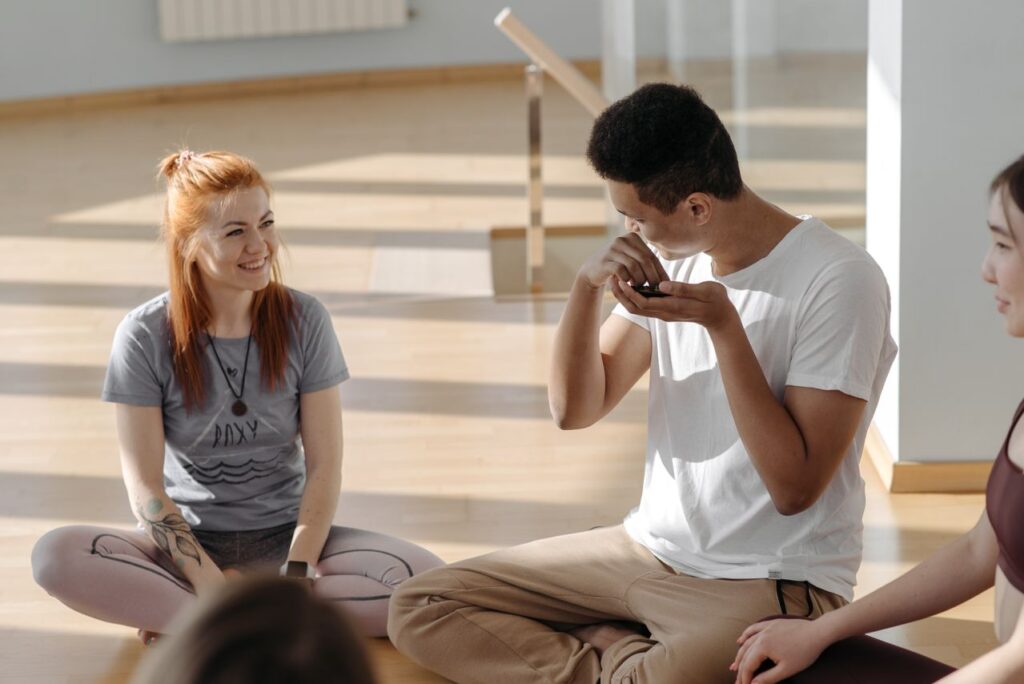
- Whether the community appears to welcome newcomers or operates as a closed group
Community is the retention factor that online platforms cannot replicate. A studio you connect with will pull you back even on low-motivation days. One that feels transactional will not. The practical work of exploring options while building consistency is its own challenge — staying consistent with your practice when your schedule changes is a skill that serves you precisely during this exploratory phase.
What If You Can’t Find Your Practice Right Away?
Not every city has an abundance of studios aligned with your specific practice. Rural areas, smaller towns, and even some urban neighborhoods have gaps. This is not a reason to pause — it’s a reason to go inward.
A home practice, even a minimal one, maintains physical and psychological continuity. Restorative and gentle yoga in particular requires almost no space, no equipment, and no experience with sequencing. They are also the most appropriate response to the physical toll of a move — tight shoulders from lifting, fatigue from disrupted sleep, a nervous system that needs calming rather than challenging. If this phase resonates, Why gentle yoga is essential when moving disrupts your routine offers a useful framework for working with the transition rather than against it.
How Do You Build Community Around Wellness in a New City?
Finding a practice is one step. Finding people is another. Research consistently shows that social connection is one of the strongest predictors of sustained physical activity — social support is among the top environmental factors influencing whether people maintain exercise habits long-term.
Some practical starting points:
- Attend workshops and special events at studios rather than only regular classes — these attract people looking to connect, not just move
- Join local running clubs, hiking groups, or outdoor fitness communities, which tend to be less intimidating to enter as a newcomer
- Use apps like Meetup or local Facebook groups to find wellness-adjacent social events
- Volunteer at local races or wellness festivals to meet people with aligned values
- Say yes to post-class conversations, even when the instinct is to put on headphones and leave
The people you meet through movement often become the people who help a new city feel like home. The community is not a bonus — it is part of the practice.
Your Practice Travels With You
Relocating your wellness routine is one of the more quietly difficult parts of moving somewhere new — underestimated because it doesn’t come with a moving checklist, and overlooked because the logistics of the move demand all available attention. But the body keeps the score of disruption, and the sooner you rebuild even a minimal version of your practice, the more stable everything else tends to feel. Start small, explore widely, stay patient with the process, and remember that the goal isn’t to replicate what you had — it’s to discover what your practice looks like in this new chapter. If you’re ready to begin, a single class is all the starting point you need.