
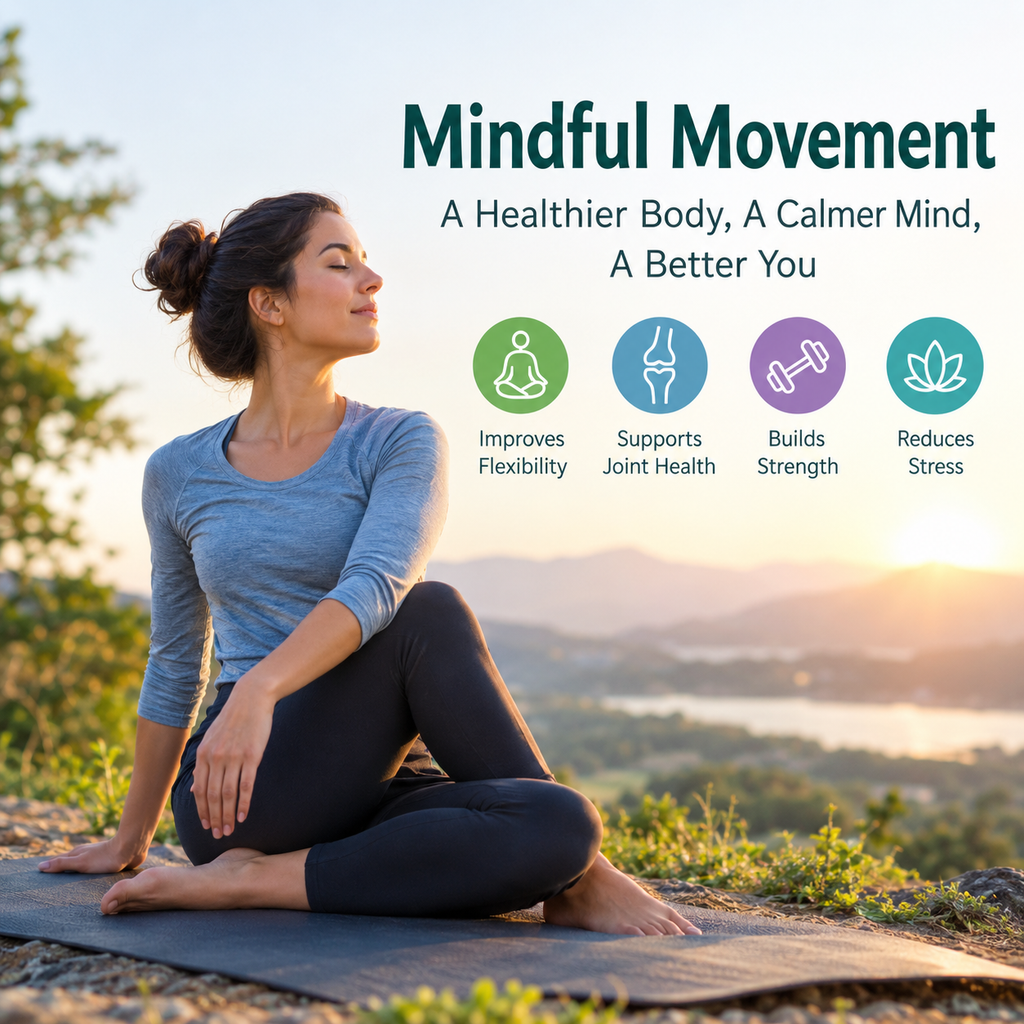
We tend to move through our day on autopilot, unaware of how our body feels. This can cause poor posture, like shoulders that move up toward the ears, or a jaw that is clenched. Often by the end of the day we feel tired and disconnected from ourselves.
Mindful movement is a practice where one gives their full attention to their body while it is in motion. Mindful movement has many forms. Some of the most common are walking, stretching, or yoga. Mindful movement allows you to pay attention to your body and movement rather than push or force your body beyond its limits, like other forms of exercise. As you practice mindful movement, your body will strengthen and your
nervous system will calm.
In this article, you will learn all about mindful movement. You will learn what it is, its benefits, and ways to easily incorporate the practice into your daily routine. The author will explain mindful movement without using complicated or hard-to-understand language. This will allow you to easily understand how to incorporate mindful movement into your daily routine.
What Mindful Movement Really Means
Mindful movement is not about following a new workout fad or doing a specific exercise. It is about the right kind of focus and presence you bring to any physical activity. Instead of getting distracted and losing focus while doing the same old body movement activities, bring your awareness to how your hamstrings feel during the stretch, what is the position of your feet during the movement and what is the current rhythm of your
breath.
Practices similar to these have been around for a long time and are adopted by different cultures around the world. Some of the popular ones are:
Yoga: A union of the mind, body and breath.
Tai Chi: A practice to increase both mental and physical awareness through slow and gentle movement.
Qigong: A Chinese practice that incorporates movement and meditation to increase mind body connection.
Another practice that embodies similar spirit is mindful walking. Mindful movement in general can be combined with other awareness based practices like a body scan to enhance the experience and learning. For example, gentle stretching with mindful movement can also be combined with a body scan to check in with the rest of the body to see how it is feeling.
The focus and the awareness in the above practices can’t be found in a traditional workout. A traditional workout is focused on a result like burning calories. Mindful movement is focused on the experience and how it feels to be moving your body. This kind of practice reduces ego and competition so you learn a lot about your true body, mind and breath.
This shift is more important than it appears. You start becoming aware of the early warning signs of injury. You can tell when your hip starts to get tight so you can adjust and work to prevent it from turning into back pain. You can tell the difference between working hard and working too much. You learn healthy effort and what is harmful. This understanding becomes one of the best tools at your disposal.
It is also helpful to understand what mindful movement is not. It is not about trying to look zen. An advanced athlete rushed and distracted by planning the rest of her day is not as mindful as a beginner who is paying attention and giving it her best effort. Performance is not the objective, and perfecting a pose is not the goal. Presence is the objective.
Physical Benefits of Mindful Movement
The practice has many physical benefits. Many of them are small and subtle but noticeable after time and consistent practice. The two biggest areas for noticeable improvement are:
Flexibility
Mindful movement focuses on controlled slow stretching. Practicing this way can gradually improve your flexibility and range of motion in your joints. Because you are paying attention and listening to your body you allow your tissues to respond to the stretch as opposed to forcing it.
Joint Health
Mindful movement focuses on controlled movements to build and improve strength and joint health. Because of this, many people see improvement in the health of their hips, hamstrings, and shoulders which are notoriously tight and hard to improve in people who sit for long hours.
Joints also benefit from gentle, repeated motion. Movement helps synovial fluid circulate; this fluid naturally lubricates joints to facilitate movement. Low impact activities such as tai chi and yoga are very popular among older adults and among those with joint stiffness, as they help keep the joints active while moving them through a range of motion.
Strength and Stability
It is common to think that gentle means weak. However, balancing on one leg or moving through a sun salutation takes muscular effort. Additionally, mindful practices have the potential to strengthen small, less active, supportive muscles around the spine and hips, that aid in balance. Improving the strength of these muscles help us perform daily activities with less risk of injury.
Improved balance promotes better posture as well. The core naturally becomes stronger as well since the deep abdominal muscles are engaged to help maintain posture and balance.
Balance
Fall prevention is a focus of practice for mindful activities, as the skill of balance naturally deteriorates with time, especially with age. Improving balance and postural stability builds athletic performance and improves overall wellness in the general population as well.
It rewards slouching. Hours in front of the laptop or phone shorten the muscles in the chest and weaken the upper back. It teaches you to notice when your posture collapses and gently correct it. Many people become aware of, and strengthen, the supporting muscles of the neck, shoulders, and lower back. While it does not take the place of medical treatment when you have a persistent and/or severe problem, it can benefit you
in managing everyday aches.
Better breathing and circulation
Mindful practices put a lot of emphasis on the breath. Gradually deepening and slowing the breath uses the diaphragm more fully which in turn, enhances the exchange of oxygen and carbon dioxide and slows the heart rate. Gentle and rhythmic movement improves circulation and helps lymph and blood move through the body. Many people feel warmer and more energized after a short session.
Deeper, restful sleep
There is a close relationship between movement and sleep. A calming practice before bed eases the transition into rest and reduces the body’s tension. Evening gentle stretching and mindful breathing help to reduce and eliminate physical and mental tension respectively, and help in moving towards deep, restful sleep.
Support for heart health and weight management
Mindful movement is usually not as intense as running or cycling, but can still be considered as a meaningful activity. Movements that raise the heart rate such as vinyasa yoga and mindful walking also support cardiovascular fitness. Mindful practices help reduce stress. Eased chronic stress helps with blood pressure control and unhealthy eating behaviors. So, mindful practices help heart health in many ways.
Mindful movement can also alter your eating habits and relationship with food in a positive way. Because mindfulness helps one pay attention to internal bodily cues, one can become more aware of feelings of hunger and fullness during meals. Because of this increased awareness, one is more likely to eat only to a point of feeling comfortably full and avoid over-eating. Improved mindful eating helps one adopt healthy eating habits, which may improve overall health and may also help with weight management.
The Mind and Body Connection You Cannot Ignore
Because our mind and body are closely linked, mindful movement works in improving both and hence is effective in improving overall health.
There are hormones, like cortisol and adrenaline, that are released when you are feeling stressed. These hormones prepared our ancestors to fight or run from a predator. This is what is known as the “fight or flight” response. However, it can turn harmful if the response stays “on” for long periods of time. Stress for long periods of time can lead to things like headaches, stomach aches, trouble sleeping and a weakened immune response. The practice of mindful movement is a great way to assist your body to get out of the “fight or flight” response and into the “rest and digest” response. To do this, pay attention to your breathing and try to keep a steady rhythm. The nervous system will then think you are safe.
It has also been found through research that people that do mindful movement are able to pause, notice and then ease tension. This is a physical way to ease stress and anxiety.
It has also been found that mindful movement is an easy way to practice meditation. While moving you can pay attention to how your feet feel pressing into the floor and then ease the tension in your body and mind.
Movement is a valuable resource, but it is just one tool, and it won’t always fix something that’s wrong. True healing comes from many sources, and sometimes the best thing to do is to talk to a professional. There are a ton of accessible resources out there, and support is becoming more like a virtual psychiatrist, which means you can work from the comfort of your own home to support your new healthy habits with mindful movement. Therapy and support are important to work through certain things, and regularly moving your body and keeping it steady are also very important.
Your body is always trying to send you messages, and aches, pains, and fatigue are not weaknesses to push through. They are signals. Move in a way that strengthens and rejuvenates you.
Here are some tips to turn your mindful movement into a life-long habit.
Five-to-ten minutes to start
Long sessions are not necessary. Multiple short sessions per day are much more effective. A great time to do this is when you first wake up or right before bed. If you time your practice to correspond to something you already do (ex. brush your teeth), then you will be more likely to remember to do it.
Find a practice that feels good
You will not want to do a practice that you find unpleasant. So, feel free to try a few different options to see what feels the best to you. A guided yoga class may be good, or you may prefer to do tai chi. If you want something less structured, you may prefer simple stretching.
Try a beginner sequence
Below is a simple practice you can do at home in around 10 minutes.
Arrive (1 minute): Stand with feet hip width apart. Close eyes if that is comfortable. Take 5 slow breaths.
Neck & Shoulder Release (2 minutes): Slowly roll your shoulders back several times. Tilt your ear toward the shoulder and take a deep breath.
Cat & Cow (2 minutes): Inhale and lift your chest and tailbone. Exhale and round your back. Repeat with the movement of your breath.
(Credit to Love Molly for practice)
Low Lunge or Hip Stretch (2 minutes): Step one foot forward, and stretch the hip of your back leg. Repeat on the other side after one minute.
Forward Fold (1 minute): Stand up straight, and hinge at the hips until your torso is parallel to the floor. If you’re able, straighten your legs, if not, bend your knees as much as you need to.
Breath Work (2 minutes): Return to a standing position or a seated position of your choice. Assess how your body feels compared to the beginning of the practice.
Focus on your breath
The mind will wonder, this is natural. The goal of this practice is to bring your awareness to your mind wandering and gently bring it back to your breath. The more you do this, the more aware of your thoughts and mind you will be, and this practice will strengthen.
Listen to your body
Pain is not a friend. The goal of this practice should be to bring your body and your mind in balance. Achieving this should be the goal. Use props to alleviate any discomfort. If there’s an injury or chronic condition you’re dealing with, check with your doctor first before engaging in any new activity.
How You Feel Over How You Look
Instead of using your appearance to measure progress, use your feelings. Are you sleeping better? Is your back less stiff? Are you dealing better with work stress? The beauty of using feelings is that you can keep track of lots of small, continuous improvements. Keeping a very short journal, like 1-2 sentences, can help reinforce the motivation and see progress.
Be Kind and Patient
There are good days and there are bad days, but both days are part of the process and equally important. Being able to master a new pose is not as important as loving and knowing your body and what it can do. Progress is always lost if you don’t continue, so you can always pick it back up where you left off.
Use Your Friends and Community
There is always power in the community and using your friends and family can help keep you on track. Scheduling practice or workouts with friends can be a good way to motivate yourself. Lots of people find that doing their practice with friends helps lighten the load and makes the practice more fun.
Conclusion: Your Body Is Ready When You Are
“Mindful movement” is the practice of using movement to achieve mindfulness. People often report improvements in flexibility, the strength of the stabilizing muscles in their body, and overall balance. It aids in pain management, cardiovascular health, and offers countless other benefits. The practice is easy to incorporate into your daily routine, as it compounds benefits with regular practice and has an immediate positive impact on your health and well-being.
To begin, set aside five minutes each day to stand mindfully. Notice how your body feels in its current state, and how it feels to simply stretch. The benefits of this practice will amaze you, and you’ll want to practice it for life! In addition to benefitting you personally, mindful movement can benefit countless others. Share this practice with family, friends, and coworkers, especially with those who need a more compassionate, gentle way to help themselves. It’s okay to be a little selfish, especially if it’s with your own health, and your well-being. Start with a single mindful breath.